What to expect when you send your mustang off to be gentled
Most people who adopt a wild horse picture that first day on their own property, the trailer ramp coming down, the horse stepping out into its new life; catching each other’s gaze and an immediate bond forming. That owner and horse are now one another’s safe space. A life-long connection, written in the stars. I mean we once rode these majestic animals into battle right?
We found Hazel posted at a BLM/USFS partner facility in Pennsylvania, untouched, and made the decision before she ever arrived “home” with us, that she needed to go somewhere with people who had done this many times before. She went straight from Pennsylvania to Rising Action Mustang Sanctuary in Vermont, and we drove up to meet her there.
That decision was one of the best we made.
Why we chose a gentling facility
Reading about gentling an untouched wild horse and actually knowing how to do it are two different things, and we were not going to figure that out at either our expense or Hazel’s. It is different from gentling a domestic-born horse, for instance, Hazel had to learn that a wheelbarrow wasn’t scary, something a young foal would have already been exposed to.
A gentling facility like RAMS exists specifically for this gap.
The staff have worked with horses at every stage of this process, from horses that arrived in rough shape emotionally to horses that moved through early foundations quickly. They know what normal looks like, what concerning looks like, and how to tell the difference.
There are other facilities like RAMS around the country doing this work. If you are in a different region, search the Mustang Hub directory for gentling programs near you. The specific facility matters less than finding one whose approach you trust and whose staff will keep you involved in the process.

The first visit
Hazel had been at RAMS for a couple of weeks when we drove up to see her for the first time (we lived four hours away). The staff had been working on the foundation, presence, approach, letting her learn that humans were not an immediate threat. Around the time Hazel had arrived at RAMS, we learned more about her background.
She had arrived with a very ragged halter on and bailing twine wrapped up in her mane. Her first post-USFS placement at a storefront in North Carolina. When that storefront abruptly closed, she had found herself at the Pennsylvania facility and now at RAMS. Because we can’t just sit still, we ended up talking to some of the former employees and found (and called) the veterinarian in North Carolina who had treated Hazel during a complicated delivery that resulted in the loss of her colt.
Our green minivan arrived at this cute farm in Vermont, located across from some dairy cows and next to a few other farms. Not sure exactly what the RAMS team expected, but highly doubt we were their typical clientele when out piled our family of five, plus a tag-along (and excuse the narration switch – going into the singular now -). While my husband unexpectedly bonded with one of their goats (cats, old folks in casinos, and apparently goats, love him) I was excited to meet everyone in person and introduce the kids to the RAMS mustangs.
Jasmine at RAMS worked to help me step into Hazel’s pen and meet with her (while my children at this point were busy discovering their inner farmer). I saw the horse I had fallen in love with online, but also like most online relationships, her photos were a bit cat-fishy. Her once beautiful mane was matted up fairy knots and bailing twine, hoofs overgrown, fur was ok but not *sleek*, and very very kind, but fearful eyes.
Under the coaching of Jasmine, I slowly reached out for my first touches with Hazel. Hazel, convinced I wanted to eat her, shook with fear and stepped back. But then – on a second (or third) ask, she slowly leaned into a soft scratch, before she remembered that I wanted to eat her, and stepped back again.
We did this for a few times, and then we bonded. How?
Being the well-trained horse girl that I am, I had arrived with not only a pink halter with matching lead rope, 934538957 other horse items that a mustang does not care about, and a bag of peppermint horse treats.
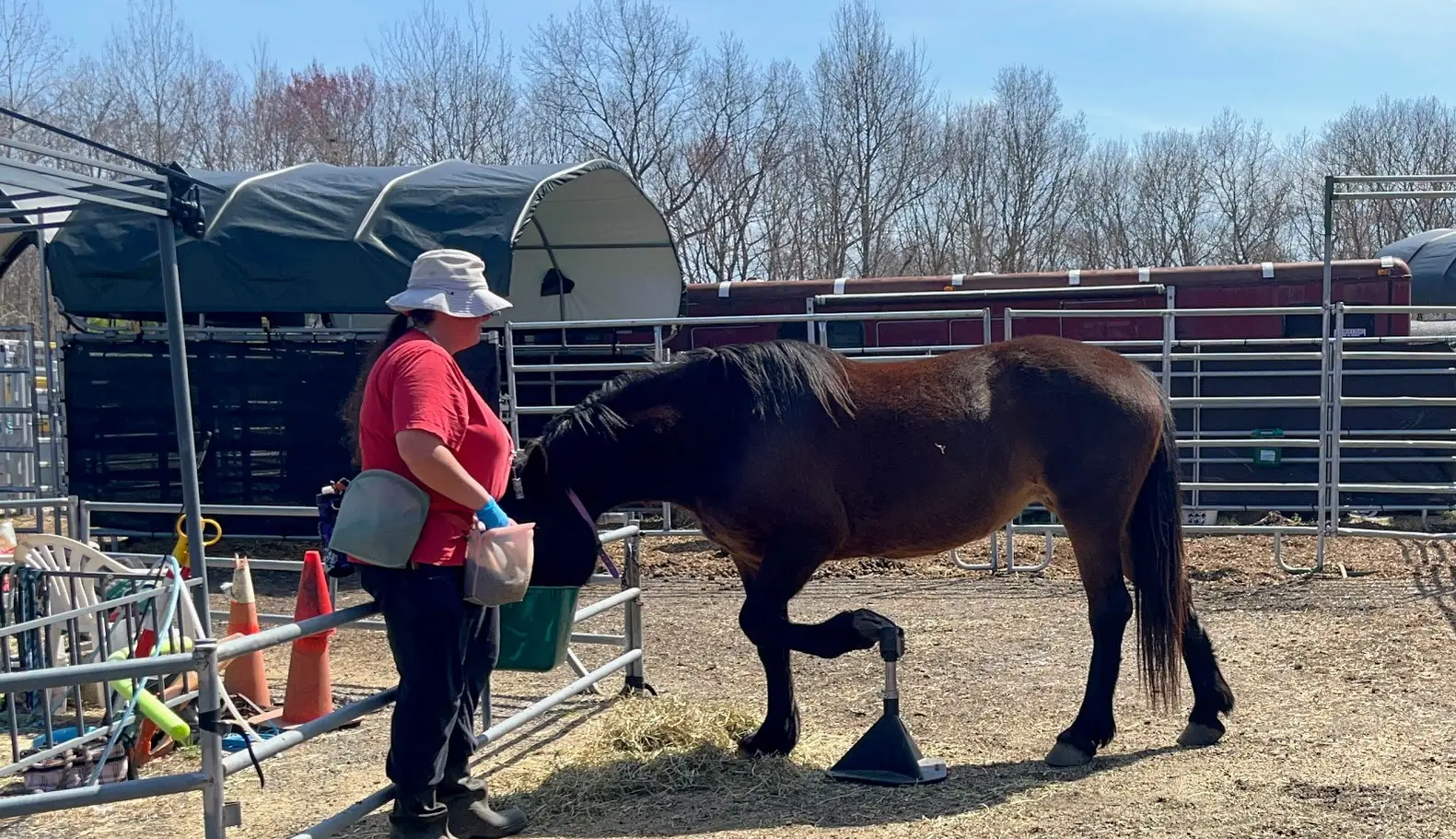
Although Hazel was not eating out of anyone’s hand at that time, she happily ate out of a feed bucket (she loves her food). I dropped a few peppermint treats in there. Hazel ate one. Hazel must have had the most euphoric, life changing experience ever and once she calmed down, demanded more in her queen-like way.
She wanted to trust. She just did not know how yet. That is the thing about mustangs, the try is in there from the beginning.
I have thought about that a lot since. Somewhere in whatever passes for association in a horse’s mind, I became the peppermint treat person. Peppermint treat people are kind. They are safe. They show up and leave good things and do not ask for anything yet. That bucket is where I think the bond actually started, before I had even brought her home, before she could be touched reliably, before any of the training milestones that came later.
Months later, after moving Hazel to her currently boarding facility and learning more about R+ training, I was told that food shouldn’t be considered a bribe, that it is a language almost, of letting a horse know that you mean safety, kindness. When I think of that, and my first times with Hazel, I have to agree. My favorite ice cream is also peppermint (Brigham’s Peppermint Stick to be exact). So I left my first visit feeling confident that Hazel and I were on the same page. Food – the universal, cross-species, love language.
What those first weeks at RAMS actually looked like
Madison and Jasmine at RAMS sent updates. Photos, notes on how sessions were going, what they were seeing from her. This is something to ask about specifically when you are evaluating a gentling facility because that communication is what lets you stay connected to a horse you are not seeing every day. They were very tolerant of us with our many questions –
Hazel moved slowly in the beginning. She was cautious, watchful, not rushing toward anything. The staff read that and worked with it rather than against it. There was no pressure to hit a timeline. The question was always what does this horse need today, not how do we get her to next week’s milestone. Patience is a virtue that I have never really had, and this is where I really appreciated Jasmine’s expertise in the process and discussing Hazel’s progress with me.
She was at RAMS for just around three months. By the time she came home she had been haltered, was accepting basic touch, and had started to build the vocabulary of trust that the next phase of her training would depend on.
We were beginning to build the picture of Hazel. Who she was as a horse: matronly, kind, but very much in charge, lover of food (sorry RAMS that she broke into your hay barn without any guilt). She left RAMS with the nickname Queen Hazel, which stuck, her official name now being DG Queen Hazel.
She also, for the record, still gets incredibly happy when she has peppermint.
What we would tell someone making this decision
Sending your horse to a gentling facility instead of bringing it straight home is not giving up on the relationship. It is the opposite. You are getting the foundation right so that when the horse does come home, you are building on something solid instead of trying to figure out first touch in your own backyard without a safety net.
It also doesn’t make you less of a trainer, horse owner, cowboy etc… It is a very specific skill set to gentle a wild mustang. And for the record we’re not talking about the “cheater” cases where you can halter on day two – because that is not typical. We still bug RAMS from time to time and they still follow up with Hazel. Heck, our daughter is considering a college in VT near them because of our visits to Hazel.
If you are looking for a gentling facility or a trainer who can help you through the early stages of mustang ownership, the Mustang Hub directory is a good place to start that search.
Red flags
In wrapping up this post, here are a few additional red flags to look out for:
- Inadequate facilities: If the facility does not meet BLM/USFS requirements, don’t risk it.
- Set timeline: Some mustangs will have their halter on in the first week, others it will take a month or more. Forcing a timeline on a horse in training isn’t a good thing, because that means the training itself is being forced, which leads to shutdown and reactive horses. Note, goals/training milestones are fine, but be wary of a trainer who promises to turn your feral wild horse into a bomb-proof kid-friendly husband horse within 30 days.
- Lack of insurance & “business stuff”: Is your trainer a registered business or non-profit? Do they have the required insurance? Are they in-line with local and state laws? At the end of the day, they’re a business and as a customer, it is ok to not work with someone who isn’t taking the necessary precautions that also protect you and your mustang.
- No contract: Protect yourself, your mustang and everyone involved. Even a basic agreement can help with communication issues down the road, or if ever required, establishing a legal paper trail in your favor.
- Internet & social media red flags: How do the mustangs in their care look on their social media platforms? Do they leave nasty comments or helpful ones? Google their name and their business name – what comes up? A friend was surprised when she googled a trainer she was talking to, and discovered that they were still involved in an animal cruelty case.
- Keep & toss: Do they seem to keep the easy ones to train and consistently re-home “difficult” mustangs. I don’t have solid data to back this claim up, but I fully believe that this type of behavior, selecting up to 4 mustangs at an auction, only working with the easy ones and then just offloading the harder ones, contributes to the influx of mustangs in kill-pens and other neglectful situations.
- Neglect: How are the animals in their care? Is there a part of the facility people are blocked from viewing? Do the other animals look well fed and groomed and if applicable, hoofs well trimmed? How are the stalls? If they’re neglectful in their care of these animals, your mustang will be neglected too.
- Communication: We’re all socially awkward. But a trainer should be able to describe their training approach, their relevant education, how often they’ll be in communication with you. They should also be able to describe which training milestones you should expect your mustang to meet once they leave their care.
If you’ve done this before, what are some of the red flags that you would tell a person looking to send their mustang to a gentling facility for the first time – let us know: contact@themustanghub.com!

Author: The Mustang Hub
The